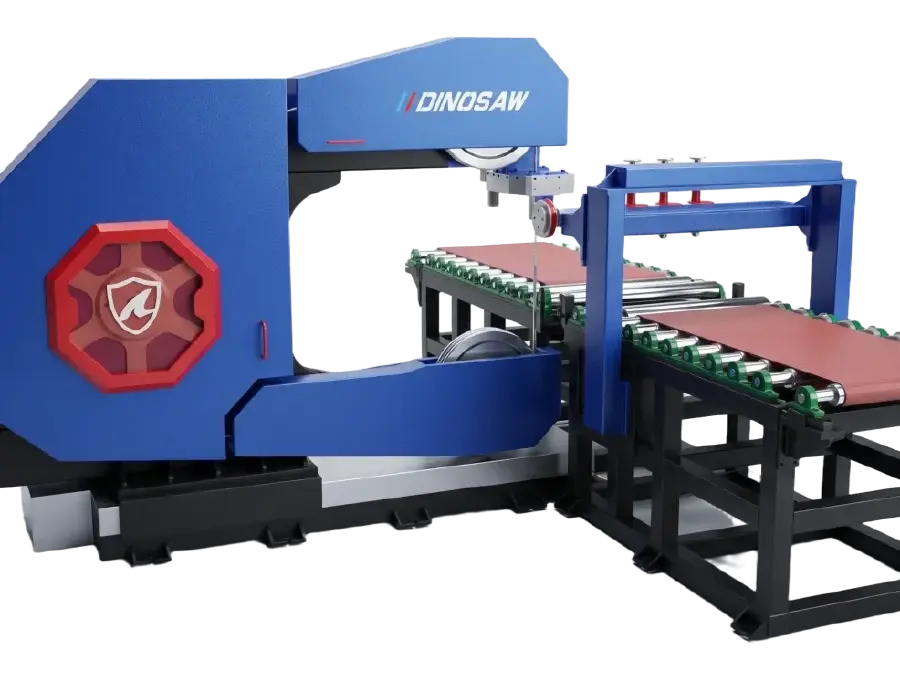
The DINOSAW Kerbstone Diamond Wire Saw Machine is an automated CNC cutting equipment engineered for the high-volume production of curved road kerbstones. Utilizing advanced diamond wire saw technology, this machine processes granite, basalt, and concrete into precise radii and chamfered profiles with a consistent accuracy of ±1mm. It serves as the definitive efficiency solution for municipal suppliers, breaking the thickness limitations of conventional bridge saws with a 400mm processing depth and an automated conveyor-belt workflow.
High-Output Kerbstone Slicing for Municipal ROI
10-20 Pieces Per Hour: Optimized for mass-market infrastructure demand, the system achieves a 100% efficiency surge over manual profiling methods, processing standardized kerbstones (20cm thickness) at steady industrial speeds.
±1mm Precision with Zero-Grinding Finish: Equipped with high-torque Siemens or Inovance servo drives, the machine ensures perfectly smooth curved edges. this superior finish eliminates the need for expensive secondary grinding, directly reducing total manual labor costs by 20%.
Unlimited Thickness Sovereignty: The wire saw architecture manages blocks up to 400mm deep, allowing fabricators to capture high-margin contracts for heavy-duty monument bases and structural road elements that exceed the reach of standard 5-axis blades.
The Authority in CNC Kerbstone Profiling Engineering
As the lead author of China’s CNC Wire Saw Industry Standard, Dinosaw has integrated its elite motion control algorithms into every kerbstone wire saw machine. This pedigree ensures that our pathing logic and tension management represent the highest level of industrial reliability for complex curved stone cutting.
Our engineering excellence is further validated by CE and ISO 9001:2015 certifications, ensuring the machine meets the most rigorous international safety benchmarks required for the USA and European markets. Built with an integrated cast-iron monoblock frame and Tier-1 components from Siemens, NSK, and ABB, these machines provide the structural rigidity necessary for a 10-year precision lifespan. Dinosaw’s proprietary automatic lubrication system effectively minimizes mechanical failures and downtime, providing a stable 24/7 production cycle trusted by leading infrastructure fabricators worldwide.
No MoldsProgram curved radii, arches and shaped outlines directly from the CNC
8.8–11 mmSlim diamond wire for curves and radii beyond blade geometry
1.2 × 2.4 mLong curved roadside elements cut in one setup
Applicable Materials
Granite, concrete, marble and building stone
Certifications & Credentials
CE Certified · ISO 9001:2015 · Industry Standard Drafting Participant · 120+ Countries & Regions Served
Specifications customizable upon request. Contact DINOSAW technical team for details
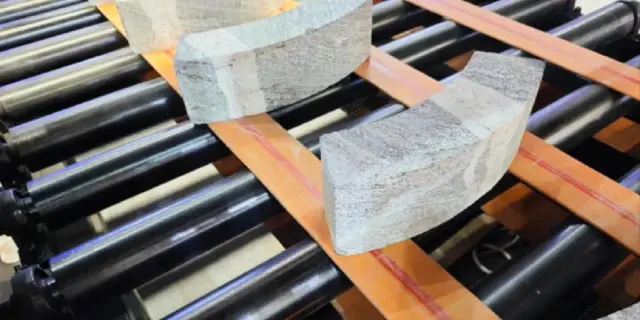
Granite ❯ Curved Kerbstones
Infrastructure Efficiency: Dinosaw Machinery Curbstone Wire Saw Machine Redefines High-Volume Municipal Production Processing curved granite kerbstones for municipal projects requires extreme output speed to maintain project deadlines. The Dinosaw Machinery Curbstone Wire Saw Machine is optimized for non-stop workflows, delivering a staggering output of 10-20 finished pieces per hour (at 20cm thickness) . By integrating Siemens or Inovance (汇川) servo drives , the Dinosaw Machinery Curbstone Wire Saw Machine ensures perfectly smooth radii and chamfers that eliminate secondary grinding, directly reducing manual labor costs by 20% .
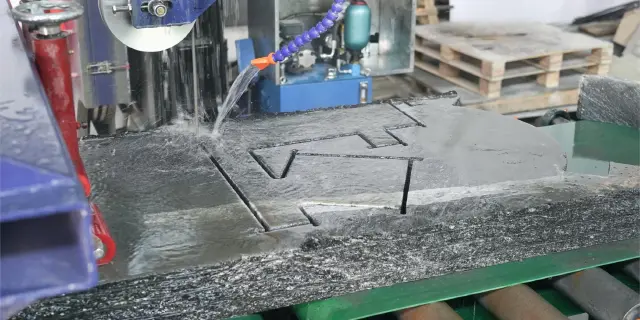
Granite ❯ Tombstones
Thickness Sovereignty: Dinosaw Machinery Curbstone Wire Saw Machine Breaks the Limits of Conventional Bridge Saws For monument workshops dealing with ultra-thick granite blocks, standard 5-axis bridge saws are often limited by their blade diameter. The Dinosaw Machinery Curbstone Wire Saw Machine allows for the effortless splitting and profiling of thick monument bases that other equipment cannot process. Built on an integrated cast-iron monoblock frame , the Dinosaw Machinery Curbstone Wire Saw Machine absorbs operational vibrations, ensuring ±1 mm precision and high-margin results for heavy-duty memorial fabrication.
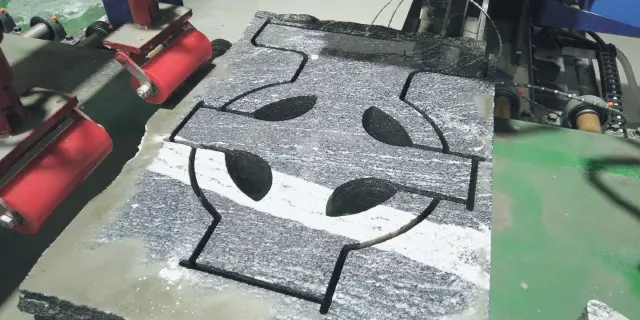
Granite ❯ Stone Crosses
Intricate Memorial Art: Dinosaw Machinery Curbstone Wire Saw Machine Masters Complex 3D Pathing Creating religious stone crosses requires precise directional changes and sharp internal corners. The Dinosaw Machinery Curbstone Wire Saw Machine utilizes high-torque Siemens or Inovance servos to provide millisecond-level feedback, ensuring zero stepping errors during complex 3D turns. By leveraging its proprietary intelligent control system , the Dinosaw Machinery Curbstone Wire Saw Machine automates the intricate cutting logic required for cross-profiling, achieving a 100% efficiency surge over manual methods.
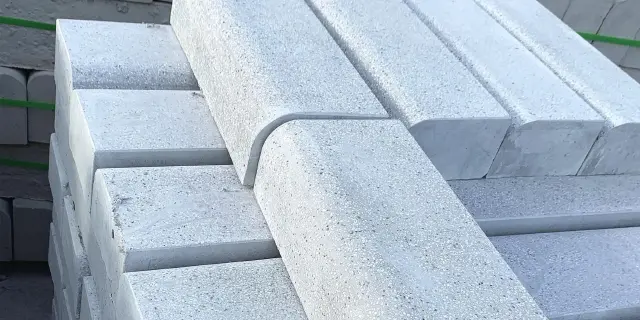
Concrete ❯ Kerbstones
Industrial Durability: Dinosaw Machinery Curbstone Wire Saw Machine Powers Through Low-Margin Mass Production In the competitive concrete kerbstone market, profitability depends on the extreme reliability of hardware to minimize maintenance downtime. The Dinosaw Machinery Curbstone Wire Saw Machine is equipped with ABB and Siemens electrical components to ensure stable 24/7 operation in harsh industrial environments. The integrated cast-iron monoblock frame of the Dinosaw Machinery Curbstone Wire Saw Machine protects the diamond wire from premature fatigue, ensuring a fast payback period and sustained ROI for infrastructure suppliers.
Real Cutting Performance & Key Metrics
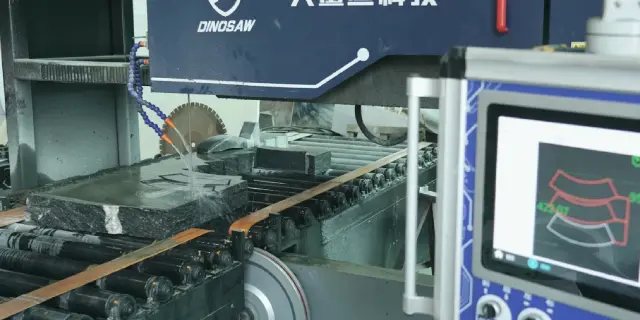
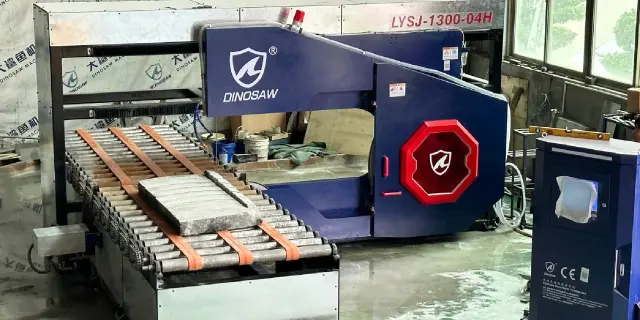
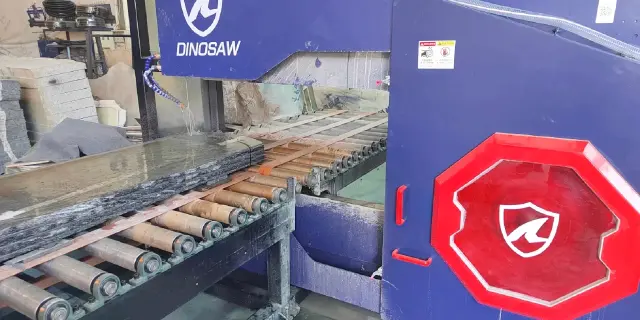
The LYSJ-1300-04H kerbstone wire saw cuts programmed curves through granite and concrete with an 8.8–11 mm diamond wire — curved kerbstones, cemetery elements and shaped roadside products without mold costs, with CNC repeatability on long continuous cuts.
No Molds
CNC Curve Programming
Curved radii, arches and shaped outlines are stored as CNC programs: every geometry is a file change, not a mold purchase — custom curved orders become economical at any quantity.
8.8–11 mm
Slim Diamond Wire
The slim diamond wire range cuts curves and small radii that wide blades cannot follow, with less edge chipping on curved granite edges.
1200 × 2400 × 400 mm
Cutting Envelope
A 1.2 × 2.4 × 0.4 m cutting envelope covers long curved kerbstones and continuous radius runs in one setup.
Stored Programs
Repeatable Batch Curves
CNC control stores each curve program: a batch of identical curved kerbstones repeats the programmed radius precisely, and a reorder months later recalls the exact file.
Applicable materials: Granite, concrete, marble and building stone.
Typical products: Curved kerbstones, radius roadside elements, cemetery stones, stone crosses, tree surround stones and custom shaped architectural elements.
Actual cutting speed varies with stone hardness, wire specification and curve radius.
Specs and options
The LYSJ-1300-04H cuts workpieces up to 1.2 × 2.4 × 0.4 m with 8.8–11 mm diamond wire at 7.5–15 kW main power. The 4.5-tonne, 5.2 × 5.0 × 2.5 m frame carries the CNC-controlled wire system for programmed curve cutting.
Model
Unit
LYSJ-1300-04H
Max. cutting size
m
1.2x2.4x0.4
Wire diameter
mm
8.8 - 11.0
Main motor power
kw
7.5 - 15
Overall dimensions
m
5.2x5.0x2.5
Approximate weight
t
4.5t
Core Technology & Machine Structure
Four engineering decisions behind the kerbstone wire saw platform. The numbered points on the machine diagram correspond to the systems below.
Curved Kerbstone Cutting Workflow
A curved cutting job follows four steps: load and reference the stone, load or program the curve path on the CNC, run the wire pass along the programmed radius, then unload the shaped piece — batch repeats recall the stored curve without re-programming.
01
Programmed Curve Cutting
Radius, arch and freeform roadside outlines are stored as CNC programs, so changing product geometry means changing the file rather than fabricating another mold — the mold cost and lead time that made small curved orders uneconomical disappear.
02
Slim Wire Geometry
An 8.8–11 mm wire follows curves and tight radii that wide circular blades physically cannot enter — the geometry limit of blade-based curve cutting is the wire's starting point.
03
Curved Edge Quality
Progressive wire contact reduces impact at the curved edge: the wire removes material along the curve instead of striking it with a full blade width, leaving cleaner granite radii and reducing secondary edge dressing.
04
CNC Batch Repeatability
CNC control stores each curve program: a batch of identical curved kerbstones repeats the programmed radius precisely, and a monthly reorder recalls the exact file — repeat municipal orders produce identical curves without re-measuring.
05
Long-Run Curve Stability
The 4.5 t frame and guided wire path keep the programmed radius stable across long continuous cuts — radius drift over a 2.4 m run is what separates a wire saw from a handheld tool, and the structure is built against it.
06
Multi-Product Flexibility
Curved curbs, cemetery stones, stone crosses, tree surrounds, landscape arcs and shaped architectural elements cut on the same setup with wire and parameter changes — one machine serves the whole shaped-roadside product range.
CNC Wire Saw vs. Mold-Based Curve Production
A production-model comparison for curved kerbstone and shaped stone buyers.
CNC Wire Saw vs. Mold-Based Curve Production
Mold-Based Production
VS
LYSJ Wire Saw
Physical mold per shape
Tooling
✓Programmed path — no molds
Mold fabrication delay
New shape lead time
✓File change, cut same day
Mold cost sets the floor
Minimum quantity
✓One piece is economical
Mold geometry limits
Small radius
✓8.8–11 mm wire follows tight curves
Mold wear over time
Batch repeatability
✓CNC-stored curve, identical repeats
Very high volume, one fixed shape
Best for
✓Varied curves & custom shaped stone
Note: configurations vary by brand and model; actual performance depends on the specific machine, material and working conditions.
The Manufacturer Behind the LYSJ Series
DINOSAW is a manufacturer of CNC stone processing machinery, specializing in diamond wire saw machines and CNC stone cutting equipment. With more than 20 years of R&D and manufacturing experience, DINOSAW contributes to industry standards including T/CMES 41001-2025 for CNC wire saw machines, holds 100+ technical patents, and supplies equipment and technical support to customers in 120+ countries and regions. Its manufacturing and management systems are certified to ISO 9001, ISO 14001 and ISO 45001, with CE-compliant machinery for international markets.
DINOSAW R&D & ManufacturingMechanical Design · CNC Control Development · Assembly · Testing · Commissioning · Global Delivery
Industry Standard Drafting
DINOSAW contributes to industry standards for stone machinery, including T/CMES 41001-2025 for CNC wire saw machines, as well as standards covering multi-wire saws, combined wire saw machines and five-axis bridge cutting equipment. This work reflects the company’s long-term involvement in machine design, manufacturing, testing and quality control.
20+Years of Stone Machinery R&D & Manufacturing Experience
100+Technical Patents — Covering machine structures, CNC control, cutting systems and stone processing technologies
120+Countries & Regions Served — Equipment, installation and technical support worldwide
CE Compliance & ISO Management Systems
CE: Stone cutting machinery assessed against Machinery Directive 2006/42/EC and relevant EN standards. ISO: Management systems certified to ISO 9001, ISO 14001 and ISO 45001.
Installation Requirements & After-Sales Support
DINOSAW provides installation guidance, operator training, remote diagnosis and spare-parts coordination for every machine.
Footprint5.2 × 5.0 × 2.5 m, 4.5 t
Wire saw layout with material access both sides.
Power Supply7.5–15 kW, configured per destination
Voltage confirmed against local standards before shipment.
Water SupplyWire cooling water, recycling recommended
Standard wet wire saw operation.
01 · Pre-Shipment & DeliveryMachine configuration, packaging and transport requirements confirmed before dispatch, with factory inspection and documents verified.
02 · Installation & CommissioningOn-site utilities and foundation check, machine positioning, commissioning and acceptance.
03 · Operator TrainingHands-on training covering routine CNC operation and daily checks of blades, spindles, cooling and lubrication.
04 · After-Sales SupportRemote technical assistance, maintenance support and spare parts coordination throughout the machine's service life.
Your Questions Answered: DINOSAW Kerbstone Diamond Wire Saw Machine
Yes. Dinosaw CNC diamond wire saw machines are designed for cutting curved kerbstones where straight cutting or segmented blade cutting leads to shape deviation or edge damage.
Why this cutting method fits curved kerbstones Curved kerbstones require continuous, controlled cutting along an arc rather than repeated straight cuts. Dinosaw uses CNC-controlled wire motion, allowing the wire to follow curved paths smoothly without frequent repositioning. This helps preserve the intended curve and reduces dimensional drift.
What types of curved kerbstones this applies to
Arc-shaped road kerbstones
Circular or semi-circular kerbs
Irregular curved kerbstones used in landscaping
Limits to understand
Extremely tight radii may require slower cutting speeds
Final surface finishing may still be needed depending on project requirements
What to confirm before deciding Confirm the minimum curve radius and length of your kerbstones to ensure the cutting path matches your design requirements.
Yes. This CNC wire saw is suitable for a wide range of curved stone products, including cemetery surround stones and tree ring stones.
Why this machine adapts to different curved products Cemetery stones and tree ring stones often combine curves with varying thicknesses. Dinosaw’s wire saw cutting applies even cutting force throughout the cut, helping maintain shape accuracy on both large and small curved components.
Materials and product types commonly processed
Cemetery surround stones
Tree ring or circular landscape stones
Custom curved stone components
Practical considerations
Heavier or thicker stones may require longer cutting cycles
Proper workpiece fixation is important to maintain accuracy
What to confirm before deciding Confirm stone dimensions, weight, and whether shapes are one-off designs or repeated profiles.
Yes. Dinosaw CNC wire saw machines can cut granite, concrete, lightweight building materials, and other stone materials commonly used in kerbstone production.
Why wire saw cutting works across materials Wire saw cutting does not rely on rigid blade contact. This allows it to handle:
Hard materials like granite
Dense materials such as concrete
Lighter building materials that may chip under blade cutting
The cutting process focuses on stability rather than impact, which helps reduce edge breakage across different material types.
Material-related trade-offs
Harder materials generally require slower cutting speeds
Softer materials may need careful parameter adjustment to avoid surface damage
What to confirm before deciding Confirm the range of materials you plan to process and whether a single machine setup needs to cover multiple material types.
Wire saw cutting reduces edge chipping by applying continuous, evenly distributed cutting force rather than concentrated blade pressure.
Why edge chipping happens with traditional methods When curved kerbstones are cut using straight blades, force is concentrated at contact points, especially near curve transitions. This often leads to chipping, spalling, or micro-cracks along the edge.
How Dinosaw wire saw cutting changes this
Continuous cutting motion along the curve
Reduced localized stress at the cutting edge
No sudden impact when changing cutting direction
This makes the cutting process more predictable, especially on brittle or hard stone materials.
What to confirm before deciding Confirm whether edge quality and reduced rework are more important than maximum cutting speed in your current process.
Yes. Dinosaw CNC wire saw machines are designed to maintain dimensional consistency on long or continuous curved cuts.
How consistency is maintained CNC control allows the wire to follow a programmed cutting path without interruption. This avoids cumulative errors caused by stopping, repositioning, or re-aligning the workpiece during long curved cuts.
Projects where multiple kerbstones must fit together precisely
Practical limits
Cutting parameters must be set correctly for long runs
Wire condition and cooling stability affect consistency
What to confirm before deciding Confirm kerbstone length, curve continuity, and acceptable dimensional tolerance for installation.
It is suitable for both custom curved stones and repeated standard shapes, without requiring CNC programming.
How custom and repeated cutting are handled Dinosaw uses a self-developed CNC control system designed specifically for stone processing. Curved cutting paths can be created by directly importing drawings, rather than writing programs. This allows both one-off custom shapes and repeated profiles to be cut using the same workflow.
For repeated production, the same cutting file can be reused to ensure each kerbstone follows the same curve. For custom projects, new drawings can be imported without changing the operating logic.
Why operation stays simple The system is designed for stone machine operators, not programmers. With on-site or remote engineer guidance, operators with basic stone machinery experience can usually start operating the machine within a few minutes. Daily operation focuses on loading the drawing, setting basic parameters, and monitoring the cut.
What this means in practice
No CNC programming required
Drawings can be imported directly for cutting
Custom and repeat orders can be handled on the same machine
Operator training time is minimal
What to confirm before deciding Confirm your drawing format, operator background, and whether your production includes both custom projects and repeat orders.
Yes. Very tight curves and small radii can be cut, but they require careful parameter control.
Why tight curves need attention As curve radius decreases, cutting resistance increases and the wire experiences greater directional change. This can affect cutting stability if speed and tension are not properly adjusted.
What typically helps with tight-radius cutting
Slower cutting speeds
Stable wire tension
Secure workpiece fixation
Practical limits
Extremely small radii may increase cutting time
Aggressive settings can increase wire wear
What to confirm before deciding Confirm the minimum curve radius in your designs and whether longer cutting cycles are acceptable.
CNC control ensures repeatability by allowing the same curved cutting path to be executed consistently for each workpiece.
Why CNC matters for curved cutting Manual cutting or segmented blade cutting relies heavily on operator skill and alignment. CNC control removes much of this variability by guiding the wire along a programmed path every time.
What repeatability improves
Uniform shape across multiple kerbstones
Easier on-site installation
Reduced adjustment or rework
What to keep in mind
Repeatability depends on stable machine setup
Wire condition and parameter consistency still matter
What to confirm before deciding Confirm whether your projects require stones to match precisely during installation.
It addresses common issues such as inconsistent curves, edge chipping, and excessive rework.
Problems often seen with manual or blade cutting
Curve deviation from repeated repositioning
Chipping at curve transitions
Inconsistent dimensions between stones
How Dinosaw wire saw cutting changes the process
Continuous cutting along the curve
Reduced mechanical shock at the cutting edge
More predictable and repeatable results
This leads to better alignment during installation and less material waste.
What to confirm before deciding Confirm whether current cutting methods cause fitting problems, visible gaps, or high rework rates.
It may not be the best choice when speed and volume are the only priorities.
Situations where this machine may not fit well
Straight kerbstone cutting with no curvature
Very high-volume, low-value stone production
Applications where surface quality and accuracy are not critical
Why this matters Wire saw cutting prioritizes accuracy and stability over aggressive material removal. In some cases, traditional cutting machines may be more efficient.
What to confirm before deciding Clarify whether your main goal is precise curved geometry and reduced rework, or maximum cutting speed and throughput.
Yes — the practical limit is wire geometry and stone behavior. The 8.8–11 mm wire follows much tighter radii than any blade, but extremely small radii concentrate wire wear and increase the risk of wire deviation in hard granite. As a working rule, the tighter the radius, the more important correct wire tension, feed rate and stone support become. For very small-radius decorative elements, send the drawing to DINOSAW for a cut feasibility check before quoting the job — the answer depends on radius, stone hardness and thickness together, not on any single number.
The production triad puts each method in its place. Volume straight kerbstones belong on the multi-blade kerbstone line — slicing twelve strips per pass beats any wire saw on cost per piece for straight products. The CNC wire saw owns the middle: varied curves, custom shapes, medium quantities and frequent product changes, where molds would be too slow and blades too limited. At the third corner, very high repeats of one simple curve may justify a dedicated mold or forming process once the quantity amortizes the tooling. If your curved orders change monthly or weekly, the wire saw is the production logic that fits; if one radius runs for years at high volume, compare against molding; if the product is straight, the multi-blade line answers first.
Yes — that is the machine's operating model. Changing between curve programs is a file recall on the CNC, not a mechanical changeover: one radius runs in the morning, a different arch in the afternoon, provided the wire specification suits both materials. What does change per job is the program verification: confirm wire tension, set feed for the stone class, and run a short test cut on the new radius before full production — the wire behaves the same, the material does not. Keep the stone support setup consistent between programs, and a multi-radius week becomes a scheduling exercise rather than a retooling exercise.
Yes — the machine cuts concrete, granite, marble and building stone, but the wire and parameters change per material. Concrete is softer and more abrasive than granite: it cuts faster at higher feed, and the wire specification favors abrasion resistance. Granite is harder and less abrasive: it cuts slower with more attention to wire tension and cooling. Running concrete parameters on granite starves the cut; running granite parameters on concrete wastes time. Per-material program cards at the machine keep the settings straight, and blade life baselines tracked separately per material stay meaningful. If your mix is mostly concrete curbs with occasional granite specials, say so at order — the wire stock recommendation follows the dominant material.
Are you looking for the perfect cutting machines or processing solutions for hard and brittle materials?
Facing challenges in stone quarrying, countertop cutting, concrete and underwater pipeline cutting, stainless steel rust removal and grinding, luxury thin slab cutting, agate and gemstone cutting, graphite cutting, or even building demolition?
Leave your inquiry, and you can expect a reply within 12 hours with tailored solutions!










 English
 中文
中文 Italian
 Türkçe
 Português
 Español
 Deutsch
 العربية
 Tiếng Việt
 Français
 Русский
 한국어
한국어