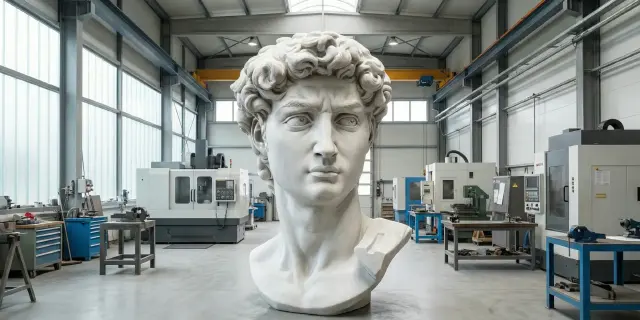
7-Axis CNC Stone Carving Robotic Arm Machine

DS-KR210 R2700
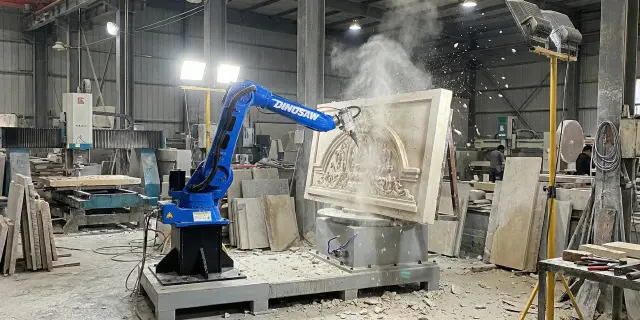
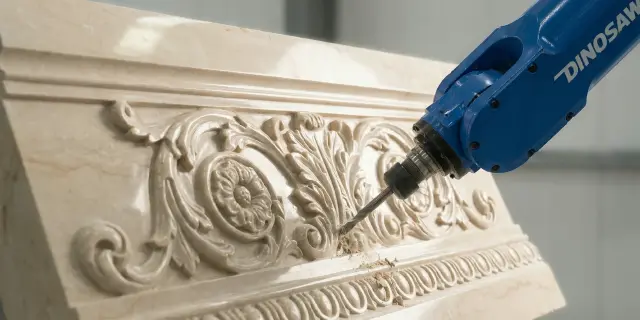
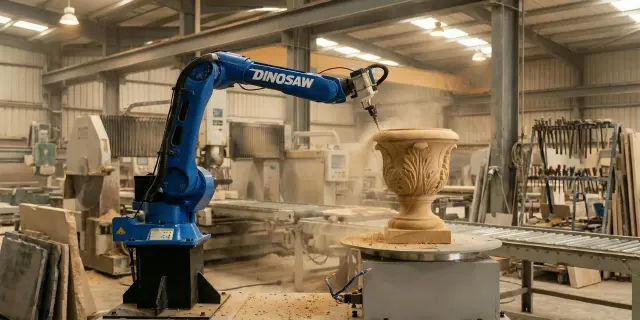
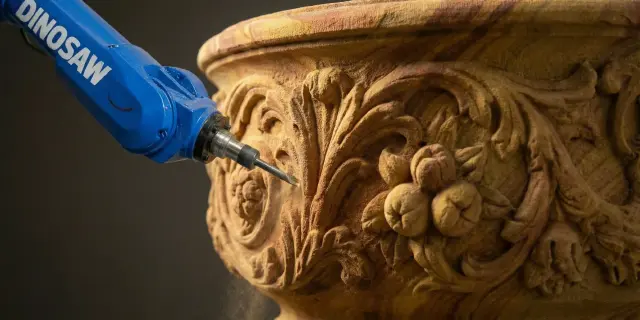
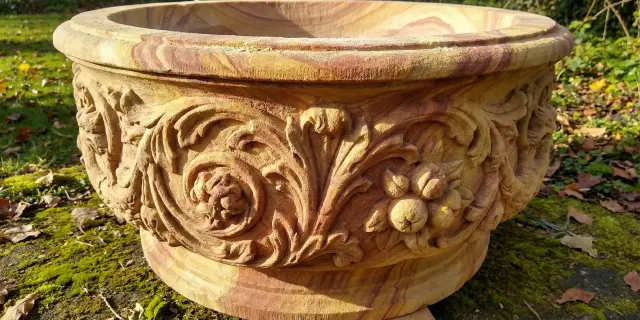
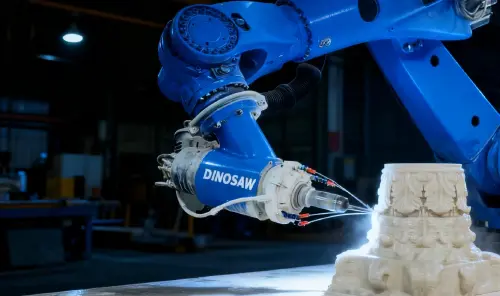
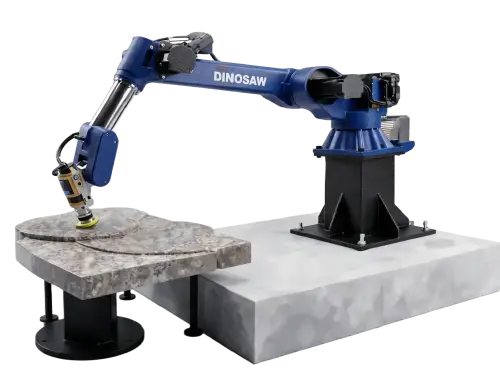
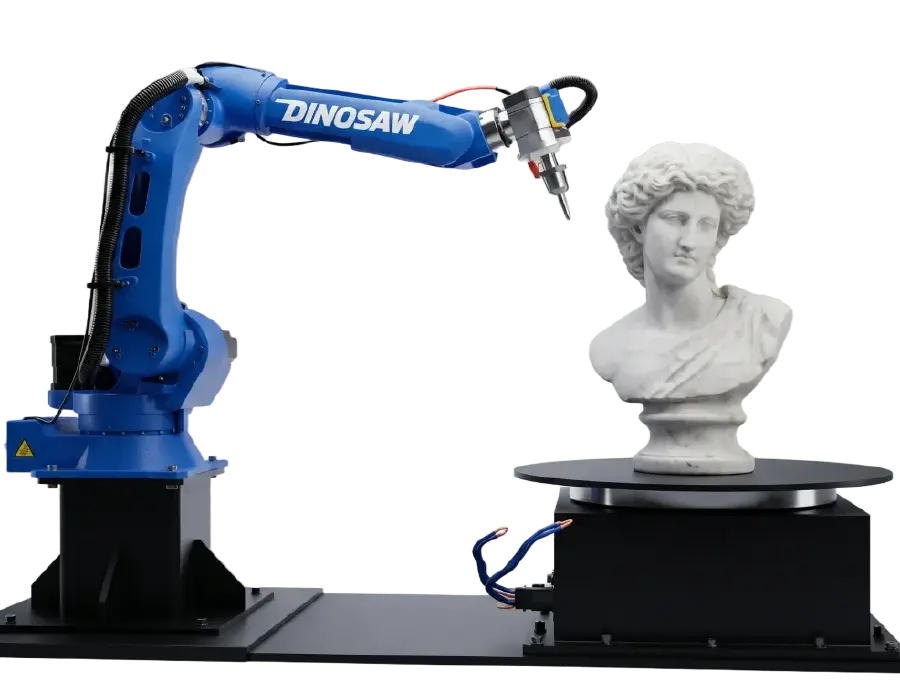
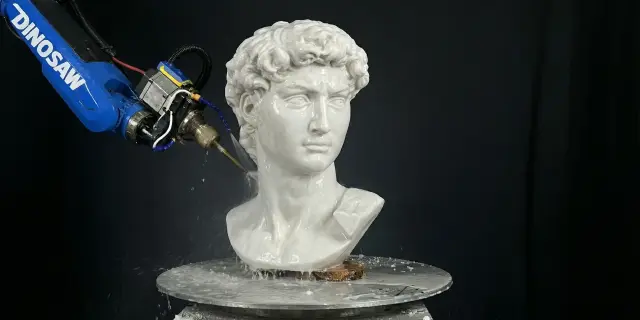
The DINOSAW 7-axis robotic arm integrates KUKA robot technology for 3D stone carving, supporting multiple tools including saw blades, mill cutters, and engraving bits. It uses SprutCAM software for complex workpiece processing with easy operation. Processes granite, marble, limestone, sandstone, travertine for diverse applications: Buddha statues, church sculptures, architectural elements, decorative panels, balustrades, columns, tombstones, milestones, and garden ornaments.
7-AxisMulti-direction tool access for undercuts, back surfaces and compound curves
±0.06 mmRepeatable reproduction from one master across production runs
3D Scan → CarveScan a physical master, generate the toolpath and reproduce it automatically

Applicable Materials

Marble, limestone, sandstone, travertine, granite and hard natural stone

Certifications & Credentials

CE Certified · ISO 9001:2015 · Industry Standard Drafting Participant · 120+ Countries & Regions Served

Compatible Materials & Products

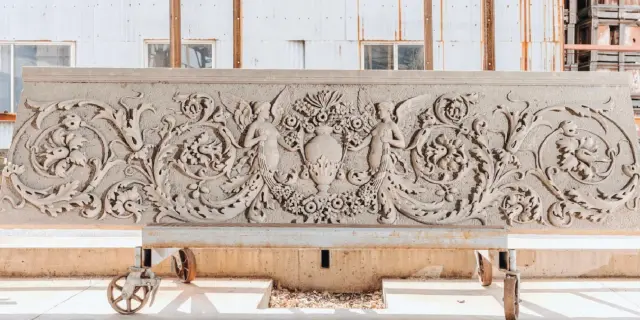
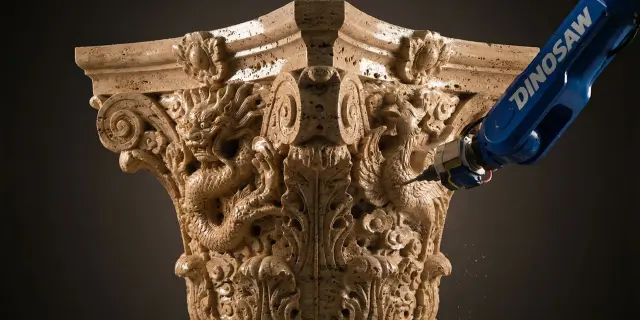
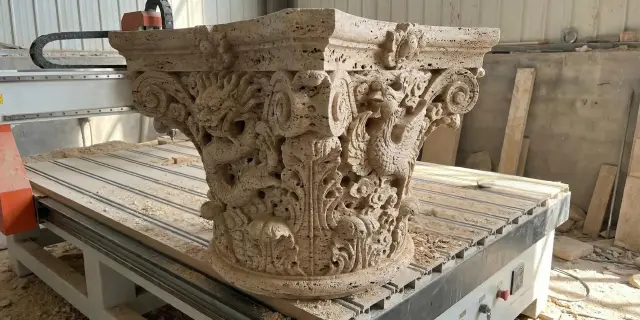
Robotic carving of sculptures, capitals and complex 3D architectural elements from digitized masters.

Real Carving Performance & Key Metrics

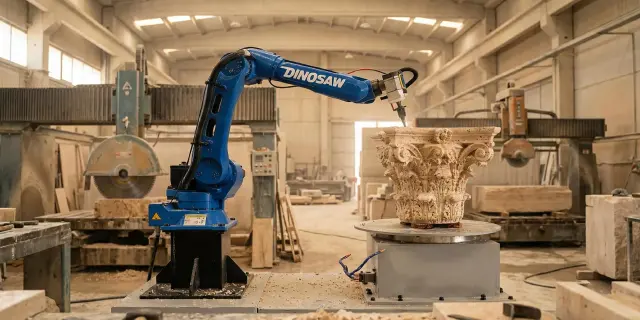
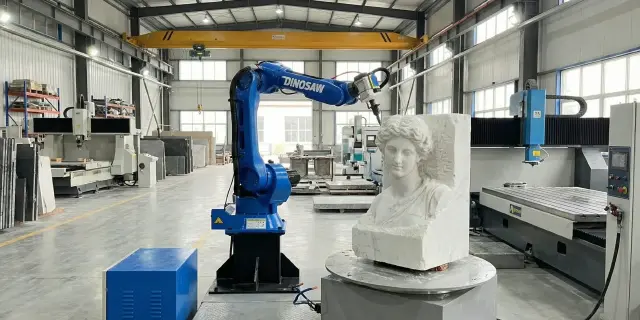
The DS-KR210 7-axis CNC stone carving robotic arm combines an industrial robot with a 15 kW stone spindle and integrated 3D scanning — sculptural facades, column capitals and complex 3D elements reproduce at ±0.06 mm repeatability, around a rotary table that presents every face without manual re-fixturing.

7 Axes

Full-Space Tool Access

Seven coordinated axes reach undercuts, side faces and compound curves that fixed-bridge CNC machines cannot approach without repeated re-fixturing.

±0.06 mm

Robotic Repeatability

Robotic positioning repeatability reproduces one approved master across unlimited production runs at identical quality.

2.7 m

Maximum Reach

2.7 m arm span with 210 kg robot payload capacity processes stones up to 2 × 2.5 m on the rotary table.

15 kW

Stone Spindle

15 kW special stone positioning spindle maintains cutting force at long reach on limestone, marble and hard granite sculptural work.

Applicable materials: Marble, limestone, sandstone, travertine, granite and hard natural stone.

Typical products: Artistic sculptures, architectural reliefs, column capitals, garden ornaments, monument profiles and complex 3D facade elements.

Stored programs can run long unattended production cycles for repeated capitals, ornaments and facade components. Actual output varies with model complexity, material hardness and toolpath strategy.

Specs and options

The DS-KR210 R2700 pairs a 210 kg-payload industrial robot at 2.7 m maximum reach with a 15 kW special stone spindle, processing stones up to 2 × 2.5 m on a Ø1 m rotary table with infinite spin. Seven axes span ±185° to ±350° per joint at up to 184°/s, keeping complex toolpaths smooth at production feed rates.

Equipment modelDS-KR210 R2700
payloads210kg Payload at maximum reach
maximum arm span2.7m
maximum processing size2x2.5 stone
rotary tableDiameter-1m, Infinite spin
spindle power15kw Special positioning stone spindle
maximum spindle speed185000rpm
number of axis7 axis fully automatic
axis 1 speed±185° 86°/s
axis 2 speed0°~-146° 84°/s
axis 3 speed155°~-119° 84°/s
axis 4 speed±350° 100°/s
axis 5 speed±125° 110°/s
axis 6 speed±350° 184°/s
axis 7 speedInfinite spin 84°/s
repeat position deviation<±0.06MM
support bladesSaw blade rough/fine engraving carving knife/end milling cutter disc/grinding disc (special needs to be customized)
automatic typeoptional
protection typeHigh waterproof and dustproof (standard protective raincoat for manipulator)

Core Technology & Machine Structure

Six core systems behind the robotic carving cell. The numbered points on the machine diagram correspond to the systems below.

Dinosaw machine 7-Axis CNC Stone Carving Robotic Arm Machine

Robotic Carving Workflow

A production run follows four steps: scan the master or import the 3D model, generate and simulate the toolpath in the integrated CAD+CAM+OLP software, run the carving cycle with the rotary table presenting each face, then inspect surface finish against the master before unload.

01

7-Axis Reach

Seven coordinated axes let the spindle approach the workpiece from directions unavailable to a fixed bridge, reaching undercuts, side faces and compound surfaces without repeated manual re-fixturing — one setup covers the whole sculpture.

02

Integrated 3D Scanning

Scan an artist's physical master or clay model and bring that geometry directly into the digital production workflow, removing manual measurement and much of the reverse-engineering work.

03

CAD + CAM + OLP Workflow

CAD design, CAM toolpath generation and Offline Programming (OLP) remain in one workflow — the carving cell is simulated and verified before the real stone is cut.

04

7th-Axis Rotary Positioning

The Ø1 m rotary table continuously presents new faces to the robot: the seventh axis allows long multi-side toolpaths without stopping for manual repositioning or re-clamping.

05

15 kW Stone Spindle

The 15 kW special positioning stone spindle sustains cutting force at the long reaches where lighter spindles lose rigidity — sculptural work in hard granite keeps feed rates instead of stalling.

06

Repeatable Master Reproduction

Once a sculpture or capital is scanned and approved, the stored program reproduces the same geometry repeatedly at ±0.06 mm robotic positioning repeatability — artistic work becomes scalable production without losing the original's detail.

7-Axis Robotic Carving vs. Traditional Gantry CNC

A capability comparison for sculptural and architectural carving buyers.

7-Axis Robotic Carving vs. Traditional Gantry CNC
Gantry CNCVSDS-KR Robot
Mainly top / limited side accessTool access✓ Multi-direction 7-axis access
Re-fixturing requiredUndercuts✓ Direct access
Multiple setupsFull sculpture✓ Continuous multi-face machining
CAD / model inputMaster reproduction✓ 3D scan physical master
Highly efficientFlat relief✓ Possible, not its main advantage
Limited by accessSculpture / capital✓ Core application

Note: configurations vary by brand and model; actual performance depends on the specific machine, material and working conditions.

The Manufacturer Behind the DS-KR Series

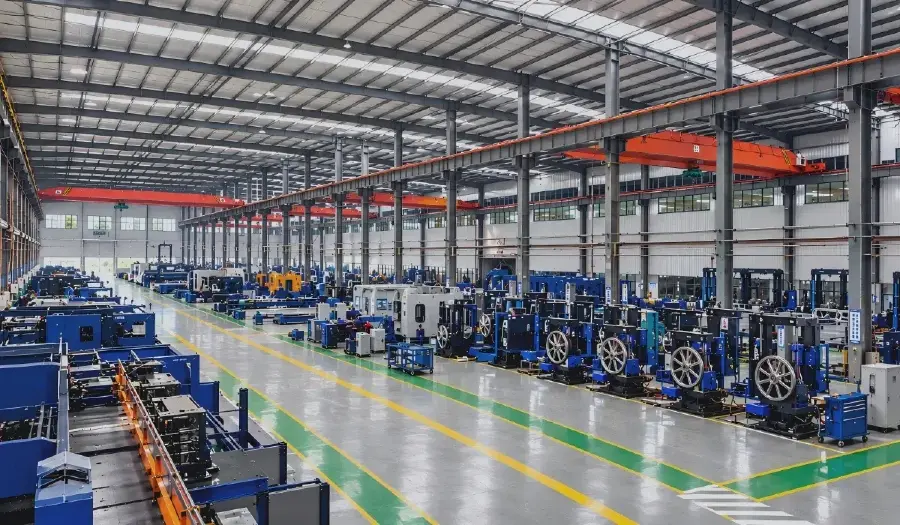
DINOSAW is a manufacturer of CNC stone processing machinery, specializing in diamond wire saw machines and CNC stone cutting equipment. With more than 20 years of R&D and manufacturing experience, DINOSAW contributes to industry standards including T/CMES 41001-2025 for CNC wire saw machines, holds 100+ technical patents, and supplies equipment and technical support to customers in 120+ countries and regions. Its manufacturing and management systems are certified to ISO 9001, ISO 14001 and ISO 45001, with CE-compliant machinery for international markets.

DINOSAW CNC stone machinery manufacturing workshop
DINOSAW R&D & ManufacturingMechanical Design · CNC Control Development · Assembly · Testing · Commissioning · Global Delivery
Industry Standard Drafting

DINOSAW contributes to industry standards for stone machinery, including T/CMES 41001-2025 for CNC wire saw machines, as well as standards covering multi-wire saws, combined wire saw machines and five-axis bridge cutting equipment. This work reflects the company’s long-term involvement in machine design, manufacturing, testing and quality control.

20+Years of Stone Machinery R&D & Manufacturing Experience
100+Technical Patents — Covering machine structures, CNC control, cutting systems and stone processing technologies
120+Countries & Regions Served — Equipment, installation and technical support worldwide

CE Compliance & ISO Management Systems

CE: Stone cutting machinery assessed against Machinery Directive 2006/42/EC and relevant EN standards.
ISO: Management systems certified to ISO 9001, ISO 14001 and ISO 45001.

Installation Requirements & After-Sales Support

DINOSAW provides installation guidance, operator training, remote diagnosis and spare-parts coordination for every cell.

FootprintRobot cell with Ø1 m rotary table

Allow reach envelope plus material access; layout plan confirmed before shipment.

Power SupplyConfigured per destination

Robot base plus 15 kW spindle; voltage confirmed against local standards.

Water SupplySpindle cooling and dust control water

Water-cooled spindle plus work-area suppression.

01 · Pre-Shipment & DeliveryMachine configuration, packaging and transport requirements confirmed before dispatch, with factory inspection and documents verified.
02 · Installation & CommissioningOn-site utilities and foundation check, machine positioning, commissioning and acceptance.
03 · Operator TrainingHands-on training covering routine CNC operation and daily checks of blades, spindles, cooling and lubrication.
04 · After-Sales SupportRemote technical assistance, maintenance support and spare parts coordination throughout the machine's service life.

DS-KR210 7-Axis Robotic Stone Carving Machine FAQ

Common Questions About 7-Axis CNC Stone Carving Robotic Arm

This 7-axis robotic arm is used for 3D stone carving, free-form cutting, and complex shape processing that cannot be handled efficiently by traditional CNC machines.

In real stone workshops, it is mainly applied to jobs where:

  • The shape is curved, sculpted, or fully three-dimensional

  • The tool needs to approach the stone from many different angles

  • Manual carving would be slow, inconsistent, or very labor-intensive

Typical uses include sculpture carving, artistic reliefs, curved architectural elements, and custom stone artworks.

This robotic arm is typically used for non-standard, high-complexity stone products, rather than flat or repetitive items.

Common products include:

  • Stone sculptures and statues

  • Artistic relief panels

  • Curved columns and decorative elements

  • Custom architectural stone features

These products usually have complex surfaces and changing tool angles, which are difficult or impossible to machine on standard 3-axis or 5-axis CNC stone machines.

The robotic arm can work with a wide range of stone materials, including:

Marble、Limestone、Sandstone、Travertine、Granite、Engineered stone and more.

In practice:

  • Softer stones allow faster carving and finer details

  • Harder stones like granite are commonly used for shaping, carving, and surface modeling rather than deep bulk cutting

Tool selection and cutting strategy are adjusted based on the material.

The main reason is freedom of movement.

Traditional CNC machines are limited by fixed axes and tool directions. A 7-axis robot can:

  • Change tool orientation continuously

  • Reach undercuts and deep curves

  • Machine complex surfaces in one setup

This reduces manual finishing and allows designs that are extremely difficult or impractical on conventional CNC systems.

It can be used for both custom projects and production work, but the way it is used is very different.

For custom or small-batch projects, the key factor is programming.
Each new product or design requires a new program to match the geometry, tool path, and cutting strategy. This means there is:

  • A learning curve

  • Setup and programming time for each new job

For workshops with engineers or operators who already have robot programming experience, this is not a problem. For others, it represents a real operational cost that needs to be considered.

For batch or production work, the robotic arm shows a different advantage.
Once the program is finalized, the same tool path can be reused to:

  • Produce large quantities of identical stone products

  • Maintain consistent shape and quality

  • Run continuously with high repeatability

In production scenarios, one-time programming enables fast, stable mass output, making the robotic arm highly suitable for automated carving and cutting lines.

In short, this machine works for both custom and production use, but it delivers the highest efficiency and value when the programming effort can be reused across multiple parts.

Once the program is finalized, this robotic arm delivers highly stable and repeatable results.

The robot offers a position repeat accuracy of ±0.05°, which is critical for:

  • Repeating the same sculpture or carving design

  • Maintaining consistent contours across multiple pieces

  • Reducing manual correction after machining

In production, this level of repeatability ensures that once the first piece is approved, the following pieces will match it closely in shape and detail.

The robotic arm has a maximum working radius of 1721 mm, which defines the effective machining envelope.

This means it can comfortably handle:

  • Medium to large stone blocks for sculpture and carving

  • Large decorative elements and architectural components

  • Complex 3D forms that require wide tool reach and flexible angles

The wide working radius allows the robot to approach the stone from multiple directions without repositioning the workpiece frequently.

The robot’s six rotating axes, each with a wide motion range, allow the tool to reach almost any angle around the stone.

For example:

  • Axis rotation ranges up to ±300° on Axis 6

  • Multiple axes operate at high rotational speeds

In real carving work, this allows:

  • Undercuts and deep curved surfaces

  • Smooth transitions between complex contours

  • Continuous machining without stopping to reset the stone

This flexibility is what makes a 7-axis robot suitable for true 3D stone carving, not just surface machining.

Yes.
The robotic arm is designed for continuous industrial operation.

Key parameters that support this include:

  • IP54 protection, suitable for dusty stone workshop environments

  • A working temperature range of 0–45°C, covering normal factory conditions

  • High axis speeds that support efficient motion without sacrificing control

These features allow the robot to run reliably in real stone processing workshops, not just controlled lab conditions.

While the robotic arm offers excellent flexibility, there are practical limits to consider:

  • Each new design requires programming and simulation time

  • Very simple, flat, or repetitive cutting tasks may be faster on traditional CNC machines

  • The effective working area is defined by the 1721 mm radius, so very large single blocks may require repositioning

Understanding these limits helps ensure the robotic arm is used where it delivers the most value: complex 3D shapes, repeatable designs, and high-value stone products.

Geometry access and reproduction model. A gantry CNC works from above with limited wrist articulation — undercuts, back-cut moldings and compound curves need multiple re-fixturings, each adding alignment error. The DS-KR210's seven axes reach those surfaces in one continuous setup, and the Ø1 m rotary table presents every face without manual re-clamping. Just as decisive for sculptural work: integrated 3D scanning digitizes the artist's master directly, and ±0.06 mm repeatability reproduces it at production scale. The trade-offs are envelope and application fit — the robot's reach covers 2 × 2.5 m stones, and large flat relief panels still run more economically on a gantry engraving machine. For full 3D sculptural volume, the robot wins; for flat panel work, the gantry remains the complementary tool.

Yes — that is the core reproduction workflow. Place the artist's original on or beside the scanning area, run the integrated 3D scan, and the digitized geometry enters the CAD+CAM+OLP chain directly: review the model, generate the toolpath, simulate the cycle, then carve the first reproduction stone. After approval, the stored program reproduces the piece at ±0.06 mm repeatability for as many copies as the order requires. This replaces manual measuring and clay-model transfer — the master craftsman's original becomes a repeatable production asset instead of a one-off.

Yes, with the toolpath and tooling matched to the material. The 15 kW stone spindle sustains cutting force on hard granite at long reach, but granite programs run with adjusted feed rates, depth per pass and tool selection versus marble or limestone. The practical difference is cycle time, not capability — a granite capital takes longer than the same capital in limestone. Specify your primary materials at order stage so DINOSAW configures the spindle package and tool recommendations accordingly.

It can cut them, but volume flat relief is usually more economical on the ZDDK gantry engraving machine. The robot's value concentrates where gantry machines reach their geometric limit — undercuts, side and back surfaces, compound curves and full sculptures. If your production is mostly flat panels, tombstone lettering and surface relief, the ZDDK's large flat bed and lower cost per panel make it the right tool; if the work includes sculptural elements, capitals and multi-face pieces, the robot earns its place. Many carving shops run both — gantry for panel volume, robot for 3D access.

Contact Dinosaw

Discuss DS-KR210 Cell Configuration & Application

Are you looking for the perfect cutting machines or processing solutions for hard and brittle materials?

Facing challenges in stone quarrying, countertop cutting, concrete and underwater pipeline cutting, stainless steel rust removal and grinding, luxury thin slab cutting, agate and gemstone cutting, graphite cutting, or even building demolition?

Leave your inquiry, and you can expect a reply within 12 hours with tailored solutions!

Prefer email?

You can also reach us at

gma@dinosawmachine.com
7-Axis CNC Stone Carving Robotic Arm Machine

What materials will you be working with? *

Your Name / Company Name? *

Phone Number / Email Address? *

+86

What specific requirements do you have?

DS-KR Guides & Related Machines

Selection guides and related equipment for sculptural carving, relief and 3D stone processing.

Get A Easy Solution

Chat Online
Ms.Lizzy

Hi, this is Lizzy from Dinosaw ( Not a Robot ).  Which Machine ( model ) do you want? Please WhatsApp us now

WhatsApp Chat Now
Contact Us

Hello 👋 How can we help?